About Me

My photo
Davis, CA, United States
Showing posts with label analysis. Show all posts

Monday, November 15, 2010

Ergonomickz #1: Seagull Entourage Rustic Acoustic Guitar

"Any problem you can't solve with a good guitar is either unsolvable or isn't a problem."


- Anonymous

---

So I'd like to take this moment to introduce my Seagull Entourage Rustic acoustic guitar. Figured if I'm gonna be doing an ergonomics analysis, it should be on an object I can actually test, right?

Right-o. Onwards!

1. Safety
It's a little hard for something like a guitar to become a weapon of destruction, but people are always strangely able to manipulate the most harmless objects into a court case. The Seagull's wooden body is strong and stiff, a hard surface that is capable of smashing into body parts. However, wood is wood, and the possibility of hitting the surface too hard could result in a huge splintering of material into ultra-thin, hard and sharp miniature skewers. Perhaps the biggest danger lies in the strings, which are capable of snapping at any moment (especially during a tuning or restringing session). Otherwise, the metal strings and frets can cause nothing more than a little roughening of fingertips during play. This usually results in the formation of callouses, which are normal for any serious guitarist.

2. Comfort
The curved shape of the Seagull allows it to rest comfortably on either leg when playing, as well as providing a  smooth edge on which to rest an arm while strumming or plucking the strings. The neck is of average width and allows the player to wrap their entire hand around without straining any muscles. Also, this guitar has an unusually slim headstock (where the tuning knobs are), which makes the tuning process slightly easier to complete because each knob is easy to locate. The also-unusual positioning of the tuning knobs parallel, rather than perpendicular, to the headstock allows the player more leverage for tuning difficult strings. The finish is also a smooth natural wood rather than lacquer, and thus doesn't cause an uncomfortable stickiness or difficulty sliding up and down the neck after long sessions of play.


3. Ease of Use
This wouldn't be a particularly good guitar for a beginning guitarist, but for one that knows what he or she is doing, the Seagull is perfect. Beginners who haven't yet developed the finger strength or calloused fingertips of a seasoned musician will find it difficult to combat the high action (how far the strings are lifted up off of the fretboard), and may become frustrated. This also hinders their ability to "bar" chords, the act of using a single finger to hold down all six strings at once. Otherwise, it isn't too hard to get a good sound out of this guitar. The tuning knobs are also friendly and twist smoothly, providing very little resistance. Ball-end strings may be used, which makes it easier to re-string the guitar alone, without having to bring it to a shop. In addition, younger players may have some difficulty with the bulkiness of a full-size guitar.

4. Performance and Productivity
With a top of solid cedar, neck of silver-leaf maple, and sides of red wild cherry wood, this Seagull guitar is practically made for the fingerstyle guitarist. The maple neck shows itself in the bright ringing mid to high tones; especially in the middle tones, maple wood provides a "bite" that sings out loud and clear without being sharp or brittle. The cedar top causes a little bit of muddying among lower tones, but at the same time, generates a warm and mellow feel for any song played and is the perfect balance to counteract the brighter high tones. Finally, the wild cherry is the balancer -- with traits of both maple and cedar, it forms the back and sides of this guitar to give it an overall intermediate sound, with defined, booming bass notes and clear, crisp high tones. These qualities make it great as a performance guitar, and the range of volume it produces also makes it a good instrument to play when relaxing at home.


5. Aesthetics
Finally, aesthetics. The majority of the guitar is made up of a varied brown palette, ranging from the dark shade of the fretboard to the beige, almost yellow bands that form a bezel around its body. The top features a gradient "burst," fitting for a guitar deemed "Rustic," that gradually goes from a dark to light brown from out to in. Even the copper-colored strings match the brown theme. The only deviations would be the characteristic black of the pickguard, as well as the silver of the tuning knobs. Furthermore, the curves of the body are reflected throughout the headstock and the rosette that surrounds the soundhole, providing consistency. The Seagull is also laterally symmetrical, with exception of the tuning knobs whose positions may be changed constantly. Overall, the guitar itself gives off a very mellow feel that matches its tone when played.

And that's that, I guess. Now.. time for a jam session.

---

Were you interested in buying a guitar? For something nice, go take a look at the selection at http://www.seagullguitars.com.

Monday, November 8, 2010

Logo-rhythms #2: Going Green

"Nothing is new except arrangement."

- William J. Durant

---

So the "big thing" going on in society recently is a movement toward being green: eco-friendliness, recycling more, sustainability, and all that jazz. Thus, it makes perfect sense that a lot of logos popping up revolve around these topics, so much that many of them have evolved into stereotypes -- icons, if you will. 

A leaf is a leaf. 

However, a green leaf is no longer just a leaf. It is a symbol of sustainability, no matter what form it comes in. Take a look at this logo:


It combines the typical lightbulb of cartoon and animated "bright ideas" with a leaf. The result? "ecoideas." In terms of logo design, it is, again, clean and crisp. Sans-serif fonts are generally "friendlier" and more modern; thus, it works great in boosting the appeal of eco-friendliness. The roundness of the characters is reflected in the lightbulb itself, which uses Gestalt principles to imply the shape of the entire lightbulb, though pieces are missing. The use of different but complementary green hues is an aesthetically pleasing touch, as it keeps the logo lively rather than flat. The bolder dark green also stands out, visually, giving a slight sense of depth, as well as emphasis on the "eco." These aren't just ideas.. they're ecoideas. Using the darker green allows for the same amount of emphasis as one would imply from bolded text.

Brilliant, in the sense that the concept is easy to grasp. But is it original? Definitely not.


Ecofuel uses the leaf in a different sense -- it's the flame of a campfire. As with the ecoideas logo, "eco" is separated from the rest of the text in a green hue, giving it emphasis. However, because the brown text is relatively the same value, the green coloration doesn't create the same kind of bolded feel as it did in the first one. 

There are plenty of other examples out there today that probably make use of the exact same techniques to promote "going green." It's alright, though -- at least it's a sacrifice of originality to go towards a good cause. And they don't look half-bad, at any rate.

---

Find these and more logos at http://brandstack.com.

Word&Image #1: Calvin and Hobbes

"Sometimes when I'm talking, my words can't keep up with my thoughts. I wonder why we think faster than we speak. Probably so we can think twice."

- Bill Watterson

---

Ah, comics: the ultimate, most versatile usage of word and image. Comics exist everywhere, whether we notice them or not. Do they have to be funny? Nope. Some are informational, like the stick-figure illustrations that describe how to put on a lifejacket in event of emergency. Some are simply stories, with their fair share of drama, character development, and perhaps, conclusion.

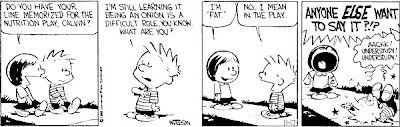
But you've got to admit, funny comics are pretty entertaining to read. Take this old Calvin and Hobbes strip, for example:


Comic strips such as these inherently rely on the interaction of words and images to relay humor. This dependence is better illustrated by literally separating the two.

Here's the same comic strip with the words removed:


We can see Calvin and Susie walking along, Susie saying.. something. Or perhaps she's just yawning. Or trying to catch bugs in her mouth. Who knows? In the second panel, Calvin gestures to himself, eyes closed, in what seems to be a pose of dramatic intent. The frame disappears as well, indicating a focused, perhaps dream-like spotlight (which, when placed in context, seems intentional -- they are talking about a play, after all). The third frame has the two of them looking relatively happy, facing each other in some sort of exchange.. but the fourth? Susie's mouth is wide open, her hands clenched in fists to suggest angry yelling. Calvin is splayed out, back to the ground, feet up, stars and a curling line implying dizziness. 

Wait, what? To tell a story like this with images alone would require many more panels, but even conveying the gist of things would require a ton of frames, perhaps showing Susie with her hands gesticulating, explaining something to Calvin, and getting progressively angrier until.. WHAM! the punch lands, and Calvin is knocked to the floor.

The point is, in a comic like this, image alone isn't capable of doing the job right. There is no sense of how much time has passed from panel to panel, and in a normal timescale where each panel is approximately the same length, it makes no sense to have Susie go from amiable to angry in such a short period. 

The use of words alone fares a little better, but not by much:

Susie: "Do you have your line memorized for the nutrition play, Calvin?"
Calvin: "I'm still learning it. Being an onion is a difficult role, you know. What are you?"
Susie: "I'm 'fat.'"
Calvin: "No, I mean in the play."
Susie: "Anyone else want to say it?"
Calvin: "Aackk! Understudy! Understudy!"

The "I'm 'fat'" joke is a little clearer here. However, the last two lines of dialogue still make little to no sense, out of context. Keep in mind that words are words.. the tone in the comic is conveyed not by diction. but by the sheer imagery and how the words are drawn on the page -- primarily, how Susie's ending line is fully capitalized, with emphasis on the "else," not to mention that the speech bubble is large, spiked, and all-around scary. Also, Calvin's "aackk" seems almost out of place without being able to see him sprawled out the way he is. 

But anyway.

At the end of the day, no matter how much analysis you put into it, Calvin and Hobbes is just a great read. Time to hit the books.. Attack of the Deranged Mutant Killer Monster Snow Goons, here I come!

---

If you love Calvin and Hobbes as much as I do, you'll probably find this search engine quite handy. Check it out at http://michaelyingling.com/random/calvin_and_hobbes.

Monday, November 1, 2010

Bang Bang, You're Dead

"What works good is better than what looks good, because what works good lasts."

- Anonymous

---

As little as we think about it in our everyday lives, the world around us is dominated by mass-produced, factory-made objects that are chugged out by the thousands every second. This type of industrial design is critical to any society; every moment, designers strive to make the next big thing better, sleeker, cleaner, easier to use. From iPods to cars to shovels, every piece manufactured can be fitted for its purpose.

However, this goal doesn't just take place in civilian society. Take the AK-47, for instance.


This assault rifle is the iPod of the military world -- more AK-47s have been produced than all other assault rifles combined.

Compared to guns that are made entirely out of metal, the wooden pistol grip, handguard, and stock make it light and highly durable, as well as cheaper to produce. With a full magazine, the gun weighs in at a mere 4.8 kg, and without, only 4.3. The magazine also serves as a stabilizer during combat, in combination with the broad end of the stock, to improve accuracy.

In terms of coloration, the dark brown of the wood and gunmetal gray of the other parts enhance the gun's ability to camouflage during combat. Viewed from the top, the AK-47 is symmetrical, but even the side view feels balanced because the small black bore is bolder and thus visually heavier in color than the brown stock, which is visually dominant in terms of volume. Edges and surfaces of the wooden pieces are slightly discolored and darker, giving a burnt, vintage feel to a gun that debuted in the early 1900s. The curvilinear design of the magazine, set slightly off to the back, flows towards the front of the gun, which also provides a sense of balance. The gradual narrowing of the entire gun from back to front forms an implied point, which implies accuracy and speed; the smoothed edges also give a sense of speed and flow.

The average soldier may not put much thought into examining the details of his weapon, especially when putting it to use. Although a gun is built primarily to fit its purpose, aesthetics do come into play, just as with any other product on the market. To what extent? Not too large, but as far as design is concerned, the AK-47 is still one of the best.

---

Sources: http://science.howstuffworks.com/machine-gun.htm/printable, http://www.ak-47.us/AK-47info.php, http://firearms.atactv.com/userfiles/image/AK%20Dis%282%29.jpg.

Monday, October 18, 2010

Ad-nalysis #1 - Pilot ExtraFine Pens

Of all the realms of design, advertisement probably has the largest passive influence on society -- from billboards to blatant product placement, advertisements heavily influence what we buy and where we get it. And unless you spend all day in a windowless room with nothing but a straw bed (one that isn't copyrighted, of course), there's no escaping their grasp.

It's no surprise, then, that the best ads use clever visuals to stand out and spark audience interest. Through the use of effective visual hierarchy, these ads for Pilot's ExtraFine-tipped pens definitely make their marks.


First is the eye-catcher. The full-body graphic immediately draws attention to the whole of each advertisement. Placed against a white background, the entire figure stands out. The few colors used (primarily yellow, blue, and black) jump out, also providing a stark contrast against the plain white.

By using Lego characters, a familiarity is established with the audience, a majority of which have probably played with the popular toys. This mental bond allows views to quickly notice the pieces that shouldn't be there -- unfamiliar dark scribbles that cover the characters' bodies. It is the unfamiliar that causes intrigue and thus leads the audience to take a closer look, only to realize that the marks are actually finely-detailed tattoos. With the knowledge that Legos are not very big, the intricacies become more brilliant. Finally, in conjunction with the macro photography that blurs the background while focusing on the fine lines, the tattoos truly stand out.

Secondary visual cues then lead viewers to notice that there is yet another entity on the page: in either top corner lies a thin pen, sporting the text "Pilot ExtraFine." The final connection is made between product and ad: Pilot ExtraFine pens have tips thin enough to draw such delicate lines on objects so small.

Many ads try to promote their product name by stating it in large, bold, in-your-face text. This ad's success lies in its ability to avoid such tactics; by exploiting the natural tendencies of visual perception, it shouts its message loud and clear.

---

Seen any interesting ads around? Leave a suggestion in the comments below!

Source: http://www.chrisrawlinson.com/2010/07/pilot-extrafine-lego-tattoo.