About Me

My photo
Davis, CA, United States

Sunday, October 17, 2010

Nothing More Than Small Talk

"Conversation should touch everything, but should concentrate on nothing."

- Oscar Wilde

---

Design.

It's that stop sign on the street corner. The poster on your wall at home and the ads on the sides of buses. It's the way the Brooklyn Bridge glows at night, and the rickety building that should've collapsed years ago. Design is pictures, design is words. Design is a language -- a conversation.

They say art is the universal language because anyone can view and enjoy it as long as their eyes still work, but art is not design. While art is meant to be appreciated (and although design embraces artistic aspects), design is meant to be understood. Regardless of form, all languages share the same function: to communicate. Design is no exception.

Every design has a purpose -- where art remains ambiguous, design speaks out.

Take websites, for example.

A well-designed website is navigable and aesthetically pleasing, providing visitors with an experience that fits the message. When you visit a site such as that of Spoon Graphics, the welcoming "Hello" in clear, sans-serif Helvetica is an eye-catcher. So what's this guy do? Easy: "I design stuff." Oh, okay, you think to yourself. Awesome.

Logically, the next few thoughts may then wander towards what this Chris Spooner designs, why he does it, who he is, or maybe even how and where he does his thing. This is where visual hierarchy comes into play.

The exchange between a visitor's thoughts and website presentation is much like contacting customer service over the phone. Using gestures and reading facial expressions is impossible -- a website relies on common sense and visual hierarchy to lead you relevant information.

For Spoon Graphics, moving previews and large, bold text in the center (a natural point of interest) draw immediate attention, and thus contain the "who" and "what." The high-contrast bar at the top takes secondary precedence, and includes other big points of interest via "about," "portfolio," and "contact" links. Additional information is then found in smaller text near the bottom for those truly interested.


But this conversation doesn't have to be a one-on-one experience. In addition to having a conversation with the audience, designs can converse with each other. They share ideas, borrow from one another, and revisit topics from the past every once in a while.

Only through communication can designs build on ideas, pull insight from a network and, through collaboration, become something amazing.

---

Examples of sites with poor design (for comparison) can be found at http://politics.freesitenow.com/basilmarceauxforgovernor/page1.html and http://www.siphawaii.com. For an ironic example of how good artists don't necessarily make good designers, take a look at http://art.yale.edu.

Monday, October 11, 2010

To Another Level of Comic Wit

"When you're an online author, you take down a barrier that can be in a book or magazine. [Publishing online] creates a sense of knowing and community around a piece of work because of access to the author and access to the readers."

-Kate Beaton

---

Remember the days when the only places a kid could go to find comics were either the newspaper or a bookstore's Graphic Novels section? Entertainment came in the form of Garfield's lazy Monday apathy, Linus's safety blanket, Dogbert's less-than-practically-viable plans to take over the world, or thelatest special-edition issue of X-Men.

Fast-forward to now.

The world of comics is rapidly changing in terms of both content and form. No need to scan the last page of Datebook for yesterday's Mutts -- checking online is quicker anyway. Can't remember the line you wanted to quote from Pearls Before Swine two weeks ago? Problem solved. "Ctrl + F" in the archives and there it is! Comic #984. The thing is, it's not just digital reproductions of newspapers and comic books that can be found online anymore.

Introducing the webcomic: this "new generation" of online-only comic strips is quickly gaining popularity in teen culture, due to its accessibility and variation. The huge variety of available webcomic genres is probably its greatest aspect, ranging from the immense nerdiness of xkcd(1) and Saturday Morning Breakfast Cereal(2) to the alluring romantic-comedy drama of Questionable Content(3). Gaming geeks can find solace in Dueling Analogs(4) or VG Cats(5), while only post-grad students can really relate to the stressing truths of PhD Comics(6).

1) xkcd

2) Saturday Morning Breakfast Cereal


3) Questionable Content


4) Dueling Analogs


5) VG Cats


6) PhD Comics


Like any comic strip, however, reader interest is drawn as much from the artwork and presentation style as the genre. While the graphic art of Wolfen(7) mimics the look and feel of a traditional Japanese manga (comic) and the stick figures of Cyanide and Happiness(8) are about as generic as the typical comic strip goes, webcomics such as A Softer World(9) and Dinosaur Comics(10) have more unique takes on how comics should look.

7) Wolfen


8) Cyanide and Happiness


9) A Softer World


10) Dinosaur Comics


Yet, the most unique feature of having comics online is that they can take advantage of the fact that readers are using the internet. And with the internet comes all those neat little benefits such as rollover text (or "alt-text"), RSS feeds, the ability to archive and search comic transcriptions, having online stores, receiving donations, a lack of middle-man interference, instant feedback, and a nearly unlimited audience pool. "The Rise of the Webcomic," an article by Jon Thompson, manages to summarize these benefits pretty well.

For those of us who have never tried our hand at starting a comic, it seems almost silly to imagine supporting yourself through webcomics alone. Some see webcomics as a hobby, and indeed, most of them start off as occasional weekend side-job, just-for-fun hobbies. However, online popularity and a dedicated readership can transform what was originally a hobby into a full-time job. 

"If you have a quality audience that likes what you do and wants to see you keep doing it, they'll even throw a couple of bucks at you once in a while," says Spike of Templar, AZ.

However, finding a home in the land of the Internet is a double-edged sword; while immense support and praising fans are easy to gain through the power of social networking and word-of-text, even a comic's biggest fans can easily turn their backs on an artist that fails to update regularly or goes into hiatus unexpectedly, whatever the reason.

To be a dedicated webcomic artist requires constant attention to consistent updates, production of the merchandise that may provide your only source of income, answering invitations to conferences at which fans expect you to be, and most importantly, remaining inspired and interested in what you do.

And that's something that goes to all artists out there. Finding the motivation to do what you love doing is probably the hardest part of being an artist, webcomic or otherwise.

But that's the beauty of it all, because motivation is really the only determining factor of online success.

In the words of Matt Melvin (Cyanide and Happiness): "We are our own bosses. The only people censoring us is ourselves."

---

Like what you see? Have some more. Read Sequential Art, Anders Loves Maria, Basic Instructions, Toothpaste for Dinner, Minus, Sinfest, Buttersafe, Savage Chickens, Chainsawsuit, and Cheer Up, Emo Kid.

Enter Through the Anteroom

"Imagine a city where graffiti wasn't illegal, a city where everybody draw whatever they liked. Where every street was awash with a million colors and little phrases. Where standing at a bus stop was never boring. A city that felt like a party where everyone was invited, not just the estate agents and barons of big business. Imagine a city like that and stop leaning against the wall -- it's wet."

-Banksy (Wall and Piece)

---

Inspiration.

Sometimes inspiration is something you really dig deep down for. A lot of artists do it. Maybe they dwell in their bedroom for days, cultivating all their pent-up emotions until finally, they throw all of that happiness or sadness or anger or frustration or peacefulness or chaos out onto a canvas, or into a short video, or a sculpture. Whatever the idea, substance is pulled from within.

But what about inspiration from, for lack of a better term.. without?

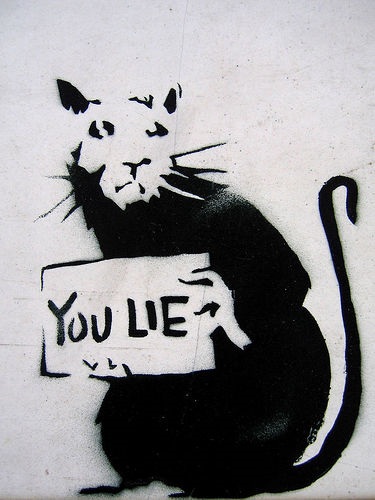
"Banksy," a British street artist from the Bristol Underground, gathers his inspiration not from his own sentiments, but those of the public. A "vandalism vigilante" of sorts, his works are often satirical outcries of dissent that otherwise go unspoken.


The world is a giant canvas at his disposal, and no rules of society have yet managed to stop him. His works appear on rooftops, on buildings, inside zoo exhibits, along sidewalks; his supporters are always on the lookout for the next Banksy painting, snapping pictures quickly before the police are called to clean it up.


Every piece is done in a characteristic stencil-art style, many making use of existing structures, signs and environments as well.


His most popular paintings take the form of a rat, a perfect representation of his style: perceived as dirty,  useless, and unwanted, graffiti is the rat of the art world.

"I'd been painting rats for three years before someone said, 'That's clever it's an anagram of art,' and I had to pretend I'd known that all along."

Other than the ephemeral (this is for you, Dr. Housefield) attractions Banksy spreads from city wall to city wall, he has been the main attraction of several exhibitions, as well as the author of five self-published books and the director of a highly-rated documentary that made its debut this year at the Sundance Festival -- Exit Through the Gift Shop: A Banksy Film.

Of course, as a safety measure, his true identity has yet to be revealed. But that's of no major concern:

"I am unable to comment on who may or may not be Banksy, but anyone described as being 'good at drawing' doesn't sound like Banksy to me." 

---

Interested in more Banksy? Visit his website at http://www.banksy.co.uk. For more cynical quotes and quips, wander over to http://www.goodreads.com/author/quotes/28811.Banksy.